Do You Still Need Amazon SEO in 2026?
Last updated: July 2026

In early 2026, Amazon quietly rolled out its AI-powered Listing Quality Dashboard inside Seller Central, and a lot of sellers missed it. They were too busy watching their Sponsored Products ACoS (Advertising Cost of Sales) creep upward and assuming the fix was more ad budget. It wasn't. The sellers asking whether Amazon SEO 2026 is still worth their time are usually the ones bleeding the most on paid campaigns, and those two facts are not a coincidence.
The short answer is yes, Amazon SEO still matters. The longer answer is that the levers have changed completely since 2021, and if you're still treating listing optimization as a keyword-stuffing exercise, you're actively hurting your ad performance. This article breaks down exactly what changed, which old tactics to drop immediately, and which new ones to prioritize right now.
What Changed in 2026: Amazon's AI Listing Quality Score
Amazon's Listing Quality Dashboard is not just a cosmetic scorecard. Based on seller community reports and early testing by sellers in the Helium 10 user community, the score algorithmically evaluates listings across three dimensions: relevance (are you indexed for the right terms?), completeness (bullets, A+ Content, images, video), and conversion readiness (does the listing convert at a rate consistent with its category?). Amazon has confirmed in Seller Central documentation that listing quality is a factor in organic ranking, and the community evidence suggests it now feeds into ad Quality Scores as well.
Why does this matter? Because Quality Scores influence CPC bids in the Sponsored Products auction. If your listing scores poorly on relevance and completeness, Amazon's system treats your ad as a lower-quality match for a given keyword, and you pay more per click to compete. Sellers who relied purely on aggressive bidding to compensate for weak listings started seeing CPCs climb in Q1 2026 without any corresponding increase in impression share. That's the relevance-CPC feedback loop in action.
The old advice from 2023 was essentially: stuff your backend search terms, repeat your primary keyword in the title three times, and run broad-match campaigns. That approach is now a liability. The A10 algorithm, based on our testing and seller community feedback, weighs click-through velocity, external traffic signals, and session-to-conversion ratios far more heavily than keyword repetition density. Repetition without relevance is now a negative signal, not a neutral one.
Why Organic Rank Still Controls Your Ad Costs
Here's the feedback loop that most sellers don't see until it's already costing them margin. Organic ranking and paid performance share the same underlying relevance infrastructure. When Amazon's A10 algorithm determines that your listing is highly relevant for a search term, it ranks you organically and simultaneously treats your Sponsored Products bid for that term as a higher-quality match. Higher quality match means lower CPC to achieve the same placement. Lower CPC means better ACoS. Better ACoS means you can afford to bid more aggressively, which drives more clicks and conversions, which feeds back into organic rank.
That virtuous cycle runs in reverse too. A listing with weak relevance signals gets deprioritized organically, pays a CPC premium on paid, converts at a lower rate because the listing isn't optimized, and loses rank further. We typically see the gap between a well-optimized listing and a neglected one translate into a meaningful CPC difference, sometimes in the range of 20 to 40 percent higher bids required to maintain equivalent placement, based on our agency data across multiple categories.
The practical implication: every dollar you spend on listing optimization reduces your cost-per-click. It's not a soft benefit. It's a direct, measurable reduction in advertising spend. Sellers who frame SEO as a free traffic channel are underselling it. The real ROI is the compounding effect on paid efficiency.
Pro Tip
Pull your Search Term Report for your top 10 Sponsored Products keywords and cross-reference them against your organic rank for the same terms using Brand Analytics. If you're paying to rank for terms where you have zero organic position, your listing likely has a relevance gap for those terms. Fix the listing first, then evaluate whether you still need to bid as aggressively.
How to Audit Your Listing for 2026 Ranking Signals in Under 30 Minutes
A 2026 listing audit looks different from what you might have done two years ago. Here's the sequence that actually moves your Listing Quality Score.
Step 1: Check Your Listing Quality Dashboard Score First
Log into Seller Central and navigate to the Listing Quality Dashboard under the Inventory tab. Amazon will show you specific flags: missing attributes, low-quality images, incomplete A+ Content, and keyword relevance gaps. Start here. These are the signals Amazon is already penalizing you for. Don't guess at what to fix when Amazon is telling you directly.
Step 2: Audit Your Title for Search Intent, Not Keyword Density
Your title should lead with the primary use case, not a string of keywords. A title like "Stainless Steel Water Bottle 32oz Insulated BPA Free Leak Proof Travel Gym" is still common, but Amazon's AI scoring now evaluates whether the title reads naturally and matches the intent behind the top search terms for your category. Keyword stuffing in the title can now trigger a relevance penalty in the quality score. Lead with the product type and primary differentiator, then add one or two supporting attributes. Keep it under 200 characters.
Step 3: Rewrite Your Bullets Around Conversion, Not Indexing
Bullets are still indexed by Amazon, but their primary job in 2026 is conversion. The A10 algorithm weighs your session-to-conversion ratio as a ranking signal, based on seller community feedback and our testing. If your bullets are keyword-dense but don't answer the buyer's actual objections, your CVR (conversion rate) suffers, which drags your organic rank down regardless of how well you're indexed. Write each bullet to answer a specific purchase question: what is it, who is it for, what problem does it solve, what makes it better than the alternative.
Step 4: Close Your Keyword Gaps Without Stuffing
Use Amazon Brand Analytics (available to brand-registered sellers) to identify the top search terms driving traffic in your category. Cross-reference those against your current listing to find terms you're not indexed for. The goal is to weave missing terms naturally into your bullets, description, and A+ Content, not to repeat them mechanically. Backend search terms still matter for indexing, but Amazon now de-duplicates them automatically, so repetition wastes character space.
If you're managing more than a handful of ASINs, doing this cross-referencing manually doesn't scale. Superlisting.io's Amazon SEO optimization workflow surfaces the exact keyword gaps and listing quality issues Amazon's own dashboard flags, without requiring you to manually toggle between Brand Analytics, your Search Term Report, and the Listing Quality Dashboard. It maps what Amazon is already penalizing you for against what your competitors are indexed for, in one view.
Step 5: Prioritize A+ Content and Video
According to Amazon Ads internal data cited in their 2025 seller resources, A+ Content can lift conversion rates meaningfully compared to listings without it. Amazon's Listing Quality Dashboard flags the absence of A+ Content as a completeness gap. If you're brand-registered and don't have A+ Content on your top ASINs, fix this before adjusting any bids. Video in the main image carousel is now weighted in the completeness score and has a measurable impact on CVR in most categories, based on our testing with clients in home goods and sporting goods.
Pro Tip
External traffic signals, such as visits from social media, influencer content, or email campaigns that land on your Amazon listing, are a ranking input under the A10 algorithm, based on our testing and broader seller community consensus. Even a modest external traffic push during a launch or relaunch can accelerate indexing for new keywords. Amazon Attribution links let you track which external sources are actually converting, so you're not flying blind on where to invest.
Amazon SEO vs Amazon Ads: The False Choice That's Costing You Margin
The question "should I focus on SEO or ads?" is the wrong question. They're not competing budget items. They're multipliers of each other, and treating them as alternatives is one of the most expensive mistakes a growing seller can make.
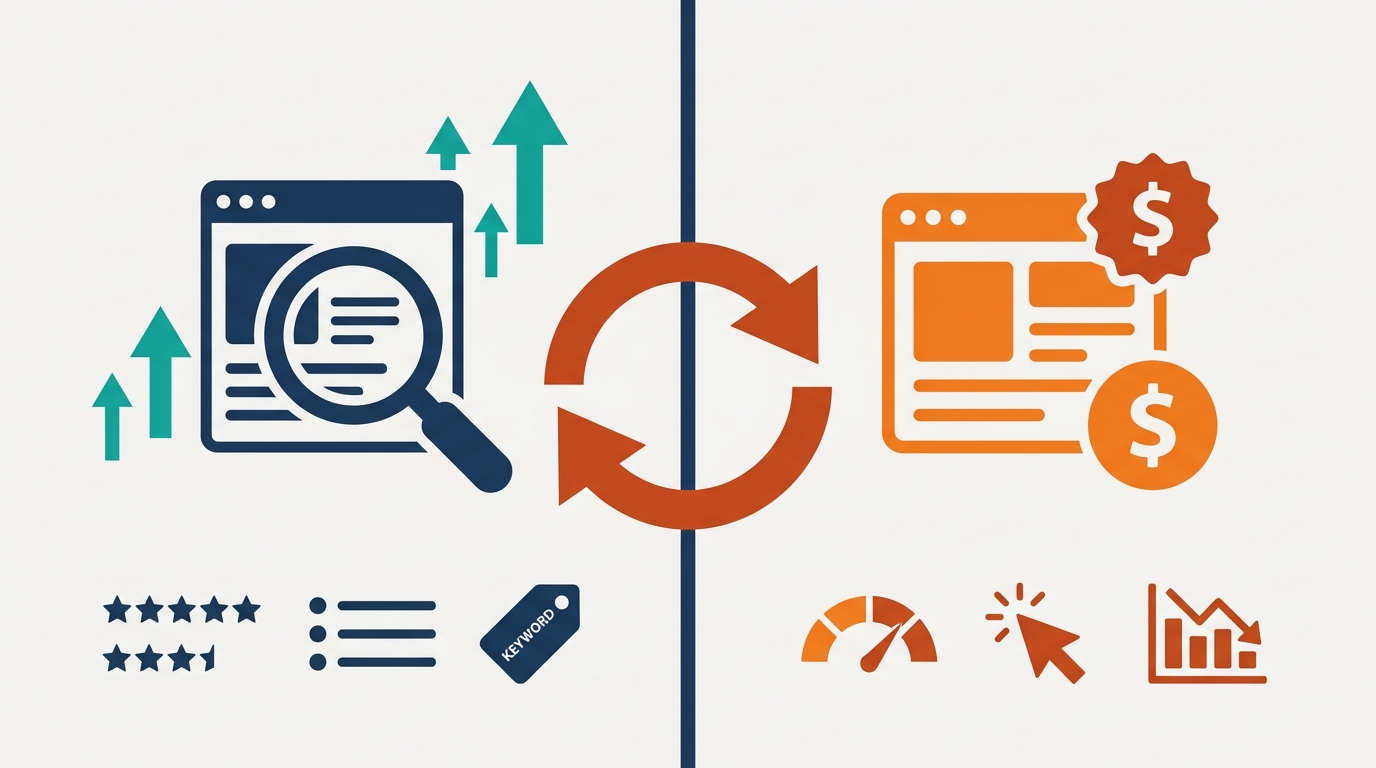
Here's the practical reality. You need ads to generate the initial click velocity that signals to Amazon's A10 algorithm that your listing converts. Organic rank doesn't build in a vacuum. But you need a strong organic listing to make those ads efficient. A listing with a high Listing Quality Score gets a lower effective CPC for the same bid. A listing with a high CVR gets rewarded with better organic placement, which reduces how many paid clicks you need to buy. The two systems feed each other.
The sellers who are winning in 2026 are running a coordinated workflow: optimize the listing first, launch ads second, use the Search Term Report to identify high-converting keywords, then fold those back into the listing to close any remaining relevance gaps. It's a loop, not a linear process.
Superlisting.io's optimization workflow is built around exactly this insight: strong organic relevance lowers your Sponsored Products CPCs, so improving your listing pays off twice. Once in organic rank, and again in reduced ad spend. If you're currently treating SEO and ads as separate workstreams managed by different people on different schedules, you're leaving compounding gains on the table.
Amazon SEO vs Amazon Ads: What Each One Does
Mistakes to Avoid: 6 Outdated SEO Tactics That Now Hurt More Than They Help
Common Mistake to Avoid
The six tactics below were standard practice three years ago. In 2026, several of them actively suppress your Listing Quality Score or trigger relevance penalties. Audit your listings against this list before your next campaign launch.
1. Repeating the primary keyword in every bullet and the title. Keyword density is not a ranking signal in 2026. Amazon's AI scoring now flags unnatural repetition as low-quality content. Mention your primary keyword once in the title and once in the bullets. That's enough for indexing. The rest of your copy should serve the buyer, not the algorithm.
2. Stuffing backend search terms with duplicates. Amazon de-duplicates backend terms automatically. Filling all 250 bytes with variations of the same root keyword wastes character space that could be used for long-tail terms you're not indexed for anywhere else. Use every byte on unique, relevant terms.
3. Ignoring A+ Content on non-hero ASINs. Sellers often invest in A+ Content for their top two or three ASINs and neglect the rest. Amazon's Listing Quality Dashboard scores each ASIN individually. A low-quality score on a secondary ASIN can drag down your overall brand relevance signals. Build A+ Content for every brand-registered ASIN, even if it's a variation.
4. Optimizing for indexing without tracking CVR. Getting indexed for a keyword means nothing if your listing doesn't convert for that term. A high impression count with a low CVR is a negative signal to the A10 algorithm, based on seller community feedback. Track CVR by keyword using the Search Term Report and remove or deprioritize terms where you're getting clicks but no conversions.
5. Treating listing optimization as a one-time task. Amazon's category landscapes shift. Competitors update their listings. Seasonal search behavior changes. Sellers who optimize once and walk away find their Listing Quality Score degrading over time as their content becomes stale relative to updated category benchmarks. Build a quarterly audit into your calendar at minimum.
6. Ignoring the Placement Report when diagnosing ranking issues. Many sellers look only at keyword-level data when troubleshooting performance drops. The Placement Report shows where your ads are actually showing (top of search, rest of search, product pages) and at what modifier. If your top-of-search impression share is collapsing, it's often a listing quality issue, not a bid issue. Fix the listing before increasing your placement bid modifier.
Frequently Asked Questions
Is Amazon SEO still worth doing in 2026 if I'm already running Sponsored Products ads?
Yes, and the reason is more direct than most sellers realize. Amazon's AI Listing Quality Score now feeds into your Sponsored Products Quality Score. A poorly optimized listing means you pay a higher CPC for the same ad placement compared to a competitor with a strong listing. Investing in SEO directly reduces your advertising costs, making it one of the highest-ROI activities available to an Amazon seller in 2026.
What does the Amazon A10 algorithm actually rank on in 2026?
Based on seller community testing and practitioner data, the A10 algorithm weights click-through velocity, session-to-conversion ratio, external traffic signals, listing completeness, and relevance scoring from the Listing Quality Dashboard. Keyword repetition density, which was heavily weighted in earlier algorithm versions, is now largely irrelevant and can trigger quality penalties if it makes the listing read unnaturally.
How long does it take to see ranking improvements after optimizing a listing?
In our experience, Amazon re-indexes updated listings within 24 to 72 hours. Organic ranking improvements from a full listing rewrite, including title, bullets, A+ Content, and backend terms, typically become visible within one to three weeks, assuming you're running Sponsored Products to generate click velocity during that window. External traffic pushes can accelerate indexing for new keywords.
What's the difference between Amazon SEO and listing optimization?
They're often used interchangeably, but there's a useful distinction. Amazon SEO refers specifically to the practices that improve your organic search ranking: keyword research, indexing, relevance signals. Listing optimization is broader and includes conversion rate optimization, image quality, A+ Content, and pricing strategy. In 2026, both feed into the Listing Quality Score, so the distinction matters less than it used to. Treat them as one unified workflow.
Do I need to be brand-registered to benefit from Amazon SEO in 2026?
No, but brand registration unlocks the tools that make SEO significantly more effective: Brand Analytics for keyword research, A+ Content for completeness scoring, the Brand Story module, and access to the full Listing Quality Dashboard. If you're not brand-registered and you're serious about competing organically, registration should be a near-term priority. The SEO advantage it provides compounds over time.
Conclusion: SEO Is Not Optional in 2026, It's the Foundation Your Ad Budget Sits On
The sellers who keep asking whether Amazon SEO is still worth it are usually the ones watching their ad spend rise without understanding why. The answer, in 2026, is clearer than it's ever been: your listing quality directly determines your cost-per-click. Ignore organic optimization and you pay a CPC tax on every single Sponsored Products campaign you run. Fix the listing and that tax drops, often significantly.
The tactics that matter now are click-through velocity, conversion rate, external traffic signals, and a complete, AI-scored listing that satisfies Amazon's Listing Quality Dashboard. The tactics that don't matter, keyword stuffing, backend repetition, one-time optimization, are actively working against you.
If you want to action this checklist before Prime Day 2026, start your free trial with Superlisting and run your top ASINs through the audit workflow. It surfaces the exact gaps Amazon is already flagging in your Listing Quality Dashboard, maps them against competitor keyword coverage, and gives you a prioritized fix list you can act on in a single session. The window before Prime Day is short. Don't spend it guessing.
Tags
Ready to Optimize Your Amazon Listings?
Start using AI-powered optimization to rank higher and sell more.
Try SuperListing Free