AEO Ranking for Beauty Brands: The 2026 Playbook
Last updated: October 2026
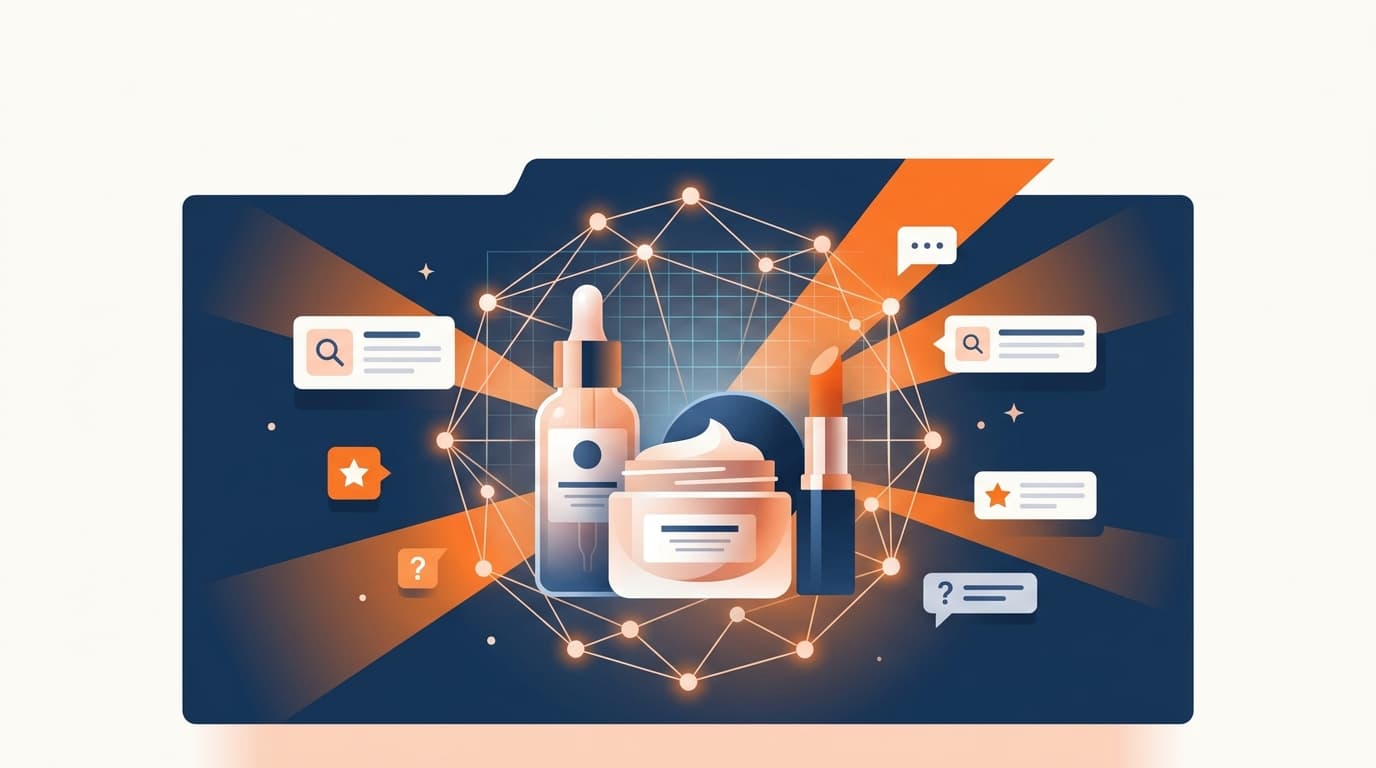
A shopper types "best vitamin C serum for sensitive skin under $40" into ChatGPT. Another asks Google's AI Mode whether a retinol is safe to layer with niacinamide. A third asks Rufus on Amazon which sunscreen won't pill under makeup. None of them scroll through ten blue links. They read one synthesized answer, built from product feeds, retailer listings, reviews, editorial roundups and Reddit threads, and they buy from the two or three brands that answer names.
That's what AEO ranking for beauty brands means in 2026. Answer engine optimization (AEO) is the work of making sure AI systems can find, understand and accurately repeat your product facts when a shopper asks a question. It's no longer an Amazon-only problem. Your Shopify product pages, your Google Merchant Center feed, your Sephora and Ulta reviews, your ingredient glossary and the dermatologist who mentioned you on YouTube all feed the same answers.
This playbook covers the full ecommerce picture: how ChatGPT, Google AI Mode, Gemini, Perplexity, Copilot and Rufus actually source beauty product data, and the channel-by-channel tactics that get your brand recommended, not just indexed.
What Changed in 2026: AI Shopping Became Multi-Surface
Eighteen months ago, "AI visibility" for a beauty brand mostly meant Amazon's Rufus and a handful of curious shoppers testing ChatGPT. That's not the landscape anymore. Four shifts happened in 2026 that matter for every beauty brand selling online, whether you're Amazon-first, DTC-first or both.
1. ChatGPT Shopping now runs on merchant feeds. Research from Profound, reported by Search Engine Journal in September 2026, found that on 10 July 2026 the share of ChatGPT product picks sourced from integrated merchant feeds jumped from 8.26% to 61.54%, and feed retrieval reached roughly 65% of tracked recommendations by early September (summary of the research). Translation: if you don't send OpenAI a product feed, ChatGPT reconstructs your products from whatever it can find on the open web. Merchants apply through chatgpt.com/merchants.
2. Shopify made every store "agent-ready." Shopify's Agentic Storefronts channel syndicates your catalog through Shopify Catalog to ChatGPT, Microsoft Copilot, Google AI Mode and the Gemini app. It was switched on by default for eligible US-selling merchants in March 2026, while Copilot and AI Mode still require a manual toggle under Settings → Sales channels (Shopify Help Center). For a DTC skincare brand on Shopify, your product data quality just became your AI ranking factor.
3. Google turned Merchant Center into its AI shopping control panel. In January 2026 Google announced the Universal Commerce Protocol (UCP), an open standard backed by Shopify, Etsy, Wayfair, Target and Walmart that lets AI agents handle discovery through checkout in AI Mode and Gemini. Google also added new Merchant Center attributes aimed at AI-generated results. And the old Content API for Shopping shut down on 18 August 2026, so any feed still writing through it stopped updating across Shopping, AI Mode and Gemini at once.
4. Amazon's AI layer kept growing. Rufus is now a default part of the Amazon app and search experience, and AI-generated review summaries condense hundreds of reviews into a few sentences that highlight recurring themes like scent, texture, breakouts and longevity.
Beauty sits right in the blast radius of all four. Skincare, haircare and cosmetics purchases are comparison-heavy and question-heavy: ingredient compatibility, skin type fit, allergens, pregnancy safety, shade matching. That's exactly the kind of research shoppers now hand to an AI assistant instead of a keyword search. The share of consumers researching products through AI assistants has climbed steadily since 2024, according to Statista, and beauty is consistently one of the categories where it shows up most.
Where Beauty Shoppers Get AI Answers in 2026 (and What Each Engine Reads)
| AI surface | Main product data source | What you control |
|---|---|---|
| ChatGPT Shopping | Merchant product feeds, then open-web pages and reviews | OpenAI product feed, Shopify Catalog, PDP content, crawler access |
| Google AI Mode, AI Overviews, Gemini | Shopping Graph, Merchant Center, indexed web pages | Merchant Center feed, schema markup, PDP and editorial content |
| Perplexity | Live web retrieval and merchant feeds | Crawlable pages, third-party citations, feed (Google Shopping format accepted) |
| Microsoft Copilot | Bing index and merchant catalogs | Shopify Agentic Storefronts toggle, Bing-indexable pages |
| Amazon Rufus | Listing content, attributes, A+, reviews, Q&A | Title, bullets, backend terms, A+ live text, review corpus |
Older SEO advice built for human skimmers, keyword density, long persuasive paragraphs, "luxurious" and "game-changing" copy, doesn't translate to a layer that rewards parseable, consistent product facts. If you need a refresher on the core ranking mechanics first, our Amazon SEO optimization guide covers the A10 fundamentals, and everything below builds on top of them.
How AI Answer Engines Read a Beauty Brand (And What They Ignore)
AI engines don't read your brand the way a shopper does. They extract and reconcile. Across every surface we've tested, beauty product answers are assembled from five layers of signals:
- Structured product data: feeds (Merchant Center, OpenAI, Shopify Catalog), Amazon attributes, and schema.org markup on your product pages.
- Your own content: product detail pages (PDPs), Amazon titles and bullets, A+ Content, ingredient glossaries, FAQ and blog content.
- Reviews and UGC: Amazon, Sephora, Ulta, Walmart, your own site, plus syndicated reviews.
- Third-party mentions: beauty editor roundups, dermatologist content, comparison blogs, Reddit communities like r/SkincareAddiction.
- Brand entity signals: how consistently your brand name, product names and core claims appear across all of the above.
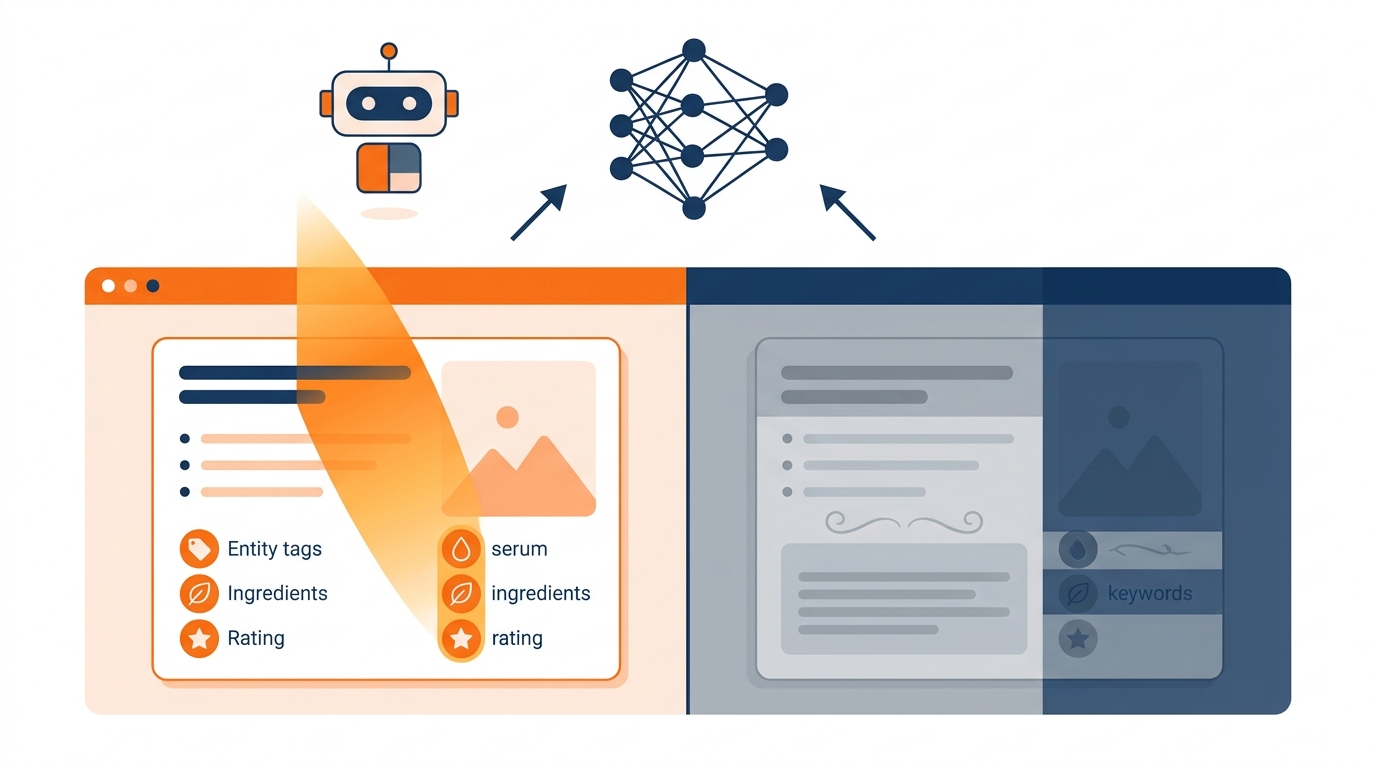
What gets ignored: adjectives with no attribute attached ("revolutionary," "luxurious," "game-changing"), claims that only exist inside images, content that only renders through JavaScript, and assertions nobody else corroborates. If your PDP says "clinically proven to reduce dark spots" but no ingredient, concentration or study detail backs it up anywhere, an AI summarizer is more likely to drop the claim than repeat it.
The bigger issue is cross-source consistency. Say your Shopify page says "fragrance-free," your Amazon listing says "lightly scented with essential oils," and three Sephora reviews mention a citrus smell. The AI layer has to reconcile three conflicting signals. In our experience, it hedges or picks the more cautious version, which is rarely the one that converts. For beauty, consistency across channels matters more than any single optimization trick.
The practical takeaway: your product content should read like a structured spec sheet with persuasive framing layered on top. Attribute first, benefit second. "10% niacinamide + 1% zinc PCA for oily, blemish-prone skin" extracts cleanly. "Our revolutionary pore-refining elixir" gives the parser nothing to lift.
Step 1: Build One Canonical Product Fact Sheet Per SKU
Before touching a feed or a listing, build a single source of truth for every product. This is the step most beauty brands skip, and it's why their facts drift between Amazon, Shopify, retailer portals and press kits.
For each SKU, document:
- → Identity: brand, exact product name, product type, size, GTIN/UPC, variants (shades, sizes).
- → Actives: key ingredients with concentrations where you can state them, plus the full INCI list as text.
- → Fit: skin or hair type, concerns addressed, finish, undertone or shade range, wear time.
- → Free-from and certifications: fragrance-free, sulfate-free, silicone-free, non-comedogenic (only if tested), vegan, cruelty-free certification (Leaping Bunny, etc.).
- → Usage and safety: how often, AM/PM, what to layer with or avoid, patch test guidance, and what you can say about pregnancy use (often "consult your doctor").
Every claim on this sheet needs a reason to exist: a formula fact, a test, a certification. That same sheet then feeds your Amazon listing, your Shopify product fields and metafields, your Merchant Center feed, your OpenAI feed, your retailer submissions and your PR kit. One sheet, pushed everywhere, kills the inconsistency problem at the source.
Pro Tip
Run a "claim diff" once a quarter. Pull the title, description and key claims for your top 10 SKUs from Amazon, your Shopify PDP, Sephora or Ulta, and your Google Shopping feed into one spreadsheet. Any row where the facts don't match word for word is a row where AI engines are currently guessing about you.
Step 2: Feed Your Product Data Directly to AI Shopping Engines
In 2026, the feed is the front door. AI shopping engines increasingly prefer data merchants push to them over data they scrape. Here's the channel map for a beauty brand:
- → Google Merchant Center: powers Google Shopping, AI Mode, AI Overviews shopping results and Gemini. Make sure your feed runs on the Merchant API (the Content API is gone), and fill the optional attributes, not just the required ones.
- → OpenAI product feed: apply at chatgpt.com/merchants. The feed can be refreshed frequently, and search visibility and in-chat checkout are separate settings, so you can be recommended without selling inside ChatGPT.
- → Shopify Agentic Storefronts: if you're on Shopify, check the channel is active, toggle on Copilot and AI Mode manually, and complete your store policies (terms, privacy, returns), which Shopify requires before activation.
- → Perplexity: its merchant program accepts Google Shopping format feeds, so a clean Merchant Center feed does double duty.
- → Amazon: fill every structured attribute in Seller Central (skin type, item form, key ingredient, special features), not just the visible copy.
Feed hygiene for beauty is specific. Group shades and sizes as proper variants of one parent, not as 40 separate products. Use real GTINs. Write factual descriptions without promotional language ("best," "#1," "miracle"), since feed specs penalize or strip it anyway. Keep price and availability accurate, because AI engines quietly drop out-of-stock products from recommendations.
To be fair, feed programs are still young and nobody has solid public performance data on organic ChatGPT Shopping yet. That's an argument for getting your feed right now, while competition is thin, not for waiting.
Step 3: Make Your DTC Product Pages Machine-Readable
Your own site is the one place you fully control, and it's where Perplexity, ChatGPT's web retrieval and Google's index go to verify what the feeds say. Most beauty PDPs are gorgeous and nearly unreadable to machines: ingredient lists inside images, claims inside sliders that load via JavaScript, and product facts spread across accordions nobody expands.
Fix it in four moves:
Add complete Product schema. Use schema.org Product JSON-LD with brand, GTIN, offers, aggregateRating and reviews, and use additionalProperty to expose beauty-specific attributes like skin type, key actives and free-from claims:
{
  "@context": "https://schema.org",
  "@type": "Product",
  "name": "Brand Name 10% Niacinamide Serum 30 ml",
  "brand": { "@type": "Brand", "name": "Brand Name" },
  "gtin13": "0000000000000",
  "description": "Serum with 10% niacinamide and 1% zinc PCA for oily, blemish-prone skin. Fragrance-free.",
  "additionalProperty": [
    { "@type": "PropertyValue", "name": "Skin type", "value": "Oily, combination" },
    { "@type": "PropertyValue", "name": "Key ingredients", "value": "Niacinamide 10%, Zinc PCA 1%" },
    { "@type": "PropertyValue", "name": "Free from", "value": "Fragrance, alcohol, silicones" }
  ],
  "offers": {
    "@type": "Offer",
    "price": "29.00",
    "priceCurrency": "USD",
    "availability": "https://schema.org/InStock"
  }
}
Put every critical fact in live HTML. The INCI list, concentrations, skin type and usage instructions should exist as text in the server-rendered page, not only in an image or a script-loaded widget. Many AI crawlers don't execute JavaScript the way a browser does.
Check your robots.txt and bot protection. Make sure you're not accidentally blocking search-oriented AI crawlers like OAI-SearchBot (ChatGPT search) or PerplexityBot. We've audited beauty sites where an aggressive CDN firewall rule was silently keeping the brand out of every AI answer.
Add a visible FAQ block on each PDP answering the five to eight questions shoppers actually ask about that product (more on that in Step 5). Clear question, clear one-line answer, then detail.
Step 4: Structure Amazon Listings for Rufus and Review Summaries
If you sell on Amazon, your listing is still one of the most heavily cited beauty data sources on the web, by Rufus and by outside AI engines alike. Stop writing titles as keyword strings and start writing them as attribute chains: brand, product type, key active and concentration, primary concern or benefit, size. A title stuffed with "best," "top rated" and five loosely related keywords gives parsers nothing to latch onto.
Apply the same logic to bullets. Each one opens with the attribute, not the adjective:
- Weak: "You'll love how this moisturizer leaves skin feeling amazing all day long."
- Strong: "24-Hour Hydration: hyaluronic acid plus ceramides lock in moisture for up to 24 hours on dry and combination skin."
The structure shifts by subcategory, and this applies to your Shopify PDPs and feeds too:
- Skincare: lead with active ingredient, concentration and skin type compatibility. Ingredient-plus-concern pairings carry the most weight.
- Haircare: lead with hair type (fine, curly, color-treated), the problem solved (frizz, breakage, buildup) and exclusions like sulfate-free or silicone-free, since those are common AI query filters.
- Color cosmetics: lead with finish (matte, dewy, satin), shade range or undertone compatibility, and wear time. Queries here skew toward "will this shade work for" and "how long does this last."
Duplicate any critical claim from your A+ graphics into live bullet or description text, keep long-tail and synonym variations in backend search terms rather than the visible title, and answer open Q&A questions with factual seller responses.
If you're managing 50+ ASINs, doing this manually doesn't scale. Superlisting.io was built exactly for this: it pulls from an existing listing URL, a PDF or product images and generates titles, bullets and backend keywords already structured as attribute-value pairs, at catalog scale instead of one listing at a time.
Step 5: Build a Question Bank and Answer It Everywhere
Shoppers don't ask AI assistants for "retinol serum." They ask "can I use retinol with vitamin C," "which retinol percentage is best for beginners," or "is this safe during pregnancy." These are the queries your content needs to answer, word for word.
Pull your real questions from every channel you have:
- → Amazon Search Term Report, Brand Analytics search query performance and your listing Q&A
- → Google Search Console queries containing "can," "is," "how," "vs" and "for"
- → Customer service tickets and live chat transcripts
- → Retailer Q&A on Sephora, Ulta and Walmart product pages
- → Reddit threads and TikTok comments mentioning your product or its key active
Organize it as a simple bank per product: the question as shoppers phrase it, where the answer lives today (if anywhere), and where it will live going forward. Most beauty brands we audit have answers to two or three of these buried in a paragraph and zero stated as a standalone, quotable line.
Then place the answers by intent. Product-specific questions go in the PDP FAQ block, Amazon A+ and bullets. Ingredient and routine questions ("retinol vs bakuchiol," "how to layer niacinamide and vitamin C") deserve dedicated guides on your blog, written as direct answers first and context second. Honest comparison pages, including ones where a competitor wins for a specific skin type, tend to get cited more than pages that claim you win everything.
Pro Tip
Write each answer so it survives being pasted alone. "Safe to layer with vitamin C: apply retinol at night and vitamin C in the morning to avoid irritation" works as a PDP line, an Amazon bullet, an A+ module and a quotable AI answer. If an answer needs the paragraph before it to make sense, rewrite it.
Step 6: Shape Your Review Corpus Across Every Retailer
AI engines don't just read your Amazon reviews. They read Sephora, Ulta, your Shopify reviews app and every retailer where your product is sold, and they compress the recurring themes into a few sentences. The theme that repeats most often wins the summary, not your best review.
Three moves matter most:
- → Ask for attribute-rich reviews. Within each platform's rules, post-purchase emails should prompt customers to describe their skin type, texture, absorption, scent and results over time. A corpus full of "great for my combination skin, absorbs in under a minute" beats a pile of generic five-star praise.
- → Syndicate reviews where you can. Review syndication networks can share verified DTC reviews to retail partners, which strengthens the same themes across more sources.
- → Audit sub-themes, not star averages. A 4.3-star product can still carry a recurring "pump breaks" or "smells different than expected" theme that an AI summary will surface regardless of the rating. Fix the product or packaging issue, then close the content gap in your bullets and PDP.
Respond to negative reviews and questions with factual corrections, not defensive marketing language. If a shopper asks whether a product contains fragrance and the honest answer is no, make sure that fact exists in your own content. Otherwise an AI agent will fill the gap with whatever it finds on a forum, accurate or not.
Step 7: Earn the Third-Party Mentions AI Engines Trust
Here's the part beauty brands underestimate. When a shopper asks "what's the best sunscreen for oily skin," AI engines lean heavily on editorial roundups, dermatologist content and community discussions to decide which brands make the shortlist. Your own site tells the engine what your product is. Third parties tell it whether your product is any good.
Where to focus:
- → "Best X for Y" roundups from beauty editors and review sites. Send them your fact sheet, not just samples, so the specifics they publish match your feed.
- → Dermatologist and esthetician content on YouTube, TikTok and blogs, where ingredient-level explanations get transcribed and indexed.
- → Reddit and community forums. Participate transparently as the brand, answer ingredient questions factually, and never astroturf. Communities spot it fast and so, increasingly, do AI engines.
Honest nuance: you can't buy your way into this layer quickly, and some of it is out of your control. But consistent facts make every mention you do earn more useful, because the AI engine can match the editor's claim to your feed and your PDP.
Step 8: Measure Your AI Visibility Across Engines
You can't improve what you don't track, and Google Search Console won't tell you whether ChatGPT recommends your serum. Set up a monthly AI visibility check:
- → Build a list of 20 to 30 real buyer prompts per product line ("best fragrance-free moisturizer for rosacea-prone skin," "drugstore alternative to [competitor]").
- → Run them across ChatGPT, Google AI Mode, Gemini, Perplexity, Copilot and Rufus.
- → Track three things: whether you're mentioned (share of voice), whether the facts are accurate, and the sentiment of the summary.
- → In GA4, segment referral traffic from chatgpt.com, perplexity.ai, copilot and gemini, and add UTM parameters to feed links where the program allows it.
Accuracy is the metric most brands miss. Being recommended with the wrong price, a discontinued shade or a claim you can't legally make is worse than not being mentioned. Tools like Superlisting.io's AI visibility tracking can automate these prompt checks across engines so you see when a competitor starts winning a query, or when an engine starts repeating an outdated fact about you.
Mistakes to Avoid When Chasing AEO Rankings for Beauty Brands
Mistake #1: Treating AEO as an Amazon-only project. Brands optimize their Amazon listing for Rufus and leave their Shopify PDPs, Merchant Center feed and retailer listings untouched. ChatGPT, AI Mode and Perplexity then build answers from the weaker, inconsistent sources. Fix it by running every content change through your canonical fact sheet and pushing it to all channels at once.
Mistake #2: Making claims AI engines (and regulators) won't repeat. Beauty is a regulated category. In the US, sunscreen SPF claims fall under OTC drug rules, and "treats acne" or "repairs damaged skin barrier" style claims can tip a cosmetic into drug territory, with similar lines drawn by Health Canada and EU rules. AI summarizers tend to drop or hedge aggressive, unsupported claims anyway. Stick to substantiated, ingredient-level facts and state test details when you have them.
Mistake #3: Hiding product facts from machines. Ingredient lists in images, claims in JavaScript sliders and bot-protection rules that block AI crawlers all make you invisible to the engines doing the recommending.
Common Mistake to Avoid
Burying your most important product facts inside graphics with no corresponding live text, whether that's Amazon A+ modules or a Shopify hero banner. If a claim only exists as text baked into an image, most AI parsers can't read it at all. Duplicate every critical attribute in real HTML.
Mistake #4: Optimizing for machines and forgetting humans. A few brands we've worked with made their copy so "extractable" that it stopped persuading anyone, and conversion rate dropped even as the content got technically cleaner. Keep the persuasive framing. Put the attribute first and the benefit second, in the same sentence.
Frequently Asked Questions
What is AEO for beauty brands?
AEO (answer engine optimization) for beauty brands is the practice of structuring product data, product pages, marketplace listings, reviews and third-party content so AI systems like ChatGPT, Google AI Mode, Gemini, Perplexity, Copilot and Amazon Rufus can find, understand and accurately recommend your products. It covers feeds and schema markup as much as copywriting.
What's the difference between SEO, AEO and GEO?
SEO aims to rank pages in search results. AEO aims to get your facts accurately used in direct answers, and GEO (generative engine optimization) aims to get your brand cited or recommended inside AI-generated responses. In practice the three overlap: clean, consistent, structured product facts help all of them.
How do I get my beauty products recommended by ChatGPT in 2026?
Submit a product feed through OpenAI's merchant program (or enable Shopify Agentic Storefronts if you're on Shopify), make sure your product pages are crawlable with complete Product schema, and keep your claims consistent across your site, marketplaces and retailers. Then build attribute-rich reviews and earn mentions in editorial roundups, since ChatGPT weighs both when choosing which products to name.
Do I need to sell on Amazon to rank in AI shopping answers?
No. ChatGPT, Google AI Mode, Gemini, Perplexity and Copilot all pull from merchant feeds and the open web, so a DTC-only beauty brand with clean feeds and strong product pages can be recommended. That said, Amazon listings and reviews are widely cited, so brands selling there should treat their listing as an AEO asset.
Does keyword research still matter for AI shopping assistants?
Yes, but the focus shifts to question-phrase keywords like "is it safe for," "can I use with" and "best for [skin type]." Pull them from Amazon's Search Term Report and Brand Analytics, Google Search Console, customer service logs and retailer Q&A. Superlisting.io offers unlimited keyword analysis on its paid plans, which makes it practical to mine this phrasing across a full catalog.
Conclusion: AEO Is Product Data Discipline, Everywhere You Sell
AEO ranking for beauty brands isn't a new marketing trick bolted onto your strategy. It's what product content management looks like now that AI engines read your catalog before most shoppers do. One canonical fact sheet, pushed to every feed, listing and product page. Questions answered in quotable lines. A review corpus and third-party mentions that reinforce your real claims. Do that, and you win both the shopper and the AI assistant summarizing you to them.
Q4 2026 is the first holiday season where ChatGPT feeds, Shopify's agentic channel, Google AI Mode and Rufus all influence beauty purchases at the same time. The brands that audit their product data across channels now will be the ones AI engines name in December.
Create a free account and run your first AEO-focused listing check before Q4 ramps up. The first check starts when you choose a plan.
Tags
Ready to Optimize Your Amazon Listings?
Start using AI-powered optimization to rank higher and sell more.
Create a free account