Alexa Shopping Optimization: AI-Readable Listings 2026
Last updated: July 2026

Alexa for Shopping Optimization: How to Make Your Amazon Listings AI-Readable in 2026
By Guillaume H., Amazon optimization specialist
Last updated: July 2026
Amazon search is no longer only a list of keywords typed into a search bar. With Alexa for Shopping, customers can now ask product questions directly inside the Amazon Shopping app, on Amazon.com, and through Alexa-powered shopping experiences. They can compare products, get AI-generated category guidance, build carts, track price history, and ask for recommendations in natural language.
That changes how Amazon listings need to be written.
To be discovered in this new shopping journey, your listing needs to do more than rank for keywords. It needs to be AI-readable. Amazon’s AI shopping assistant needs to understand exactly what your product is, who it is for, what problem it solves, what makes it different, and when it should be recommended over alternatives.
This is why we built the new Alexa For Shopping Optimizer inside Superlisting.io.
The feature helps Amazon sellers and brands analyze whether their product listings are clear enough for AI-assisted shopping experiences. Instead of only checking keyword density, the Alexa For Shopping Optimizer looks at your listing the way a shopping assistant would: product type, use case, customer intent, ingredients, materials, compatibility, benefits, objections, Q&A gaps, and structured attributes.
In short: it helps you understand whether your product can be found where customers are now searching: not only through traditional Amazon SEO, but through conversational search, AI product comparisons, Alexa for Shopping prompts, and voice-assisted purchase journeys.
This guide gives you a field-by-field framework for Alexa for Shopping optimization on Amazon listings in 2026: what changed, what to rewrite, what to stop doing, and how to structure your listing so both customers and AI shopping assistants can understand it.
What Changed With Alexa for Shopping in 2026
Classic Amazon search was built around keywords, indexing, relevance, conversion rate, price, availability, and seller performance. A customer typed a query, Amazon returned a product grid, and the shopper visually compared titles, images, reviews, prices, badges, and offers.
Alexa for Shopping introduces a different layer of discovery. The customer may not start by scanning a search results page. They may ask a question, request a comparison, describe a problem, or ask Amazon’s AI shopping assistant to recommend the best option for a specific need.
For example, a customer may not search for:
- “protein powder chocolate”
- “quiet blender”
- “kids lunch box”
They may instead ask:
- “What is a good protein powder without artificial sweeteners?”
- “Find me a quiet blender for morning smoothies.”
- “What is a good leak-proof lunch box for a five-year-old?”
These searches do not behave like traditional head-term searches. They contain context, intent, constraints, objections, and decision criteria. If your listing does not clearly expose those signals, AI shopping systems have less confidence recommending your product.
This is the key shift: Amazon listings now need to be optimized for both search engines and shopping assistants.
Introducing Superlisting.io’s Alexa For Shopping Optimizer
Most Amazon listing tools were built for the old version of Amazon SEO: find keywords, insert keywords, track rank, repeat.
That is still important, but it is no longer enough.
With Alexa for Shopping, Amazon is moving toward a more conversational discovery layer. Customers are not only typing short keywords anymore. They are asking specific questions like:
- “Which collagen powder is best for women over 40?”
- “Find me a magnesium supplement for sleep without melatonin.”
- “What is the best stainless steel water bottle that keeps drinks cold all day?”
- “Compare protein powders with no sugar alcohols.”
- “What is a good baby shampoo for sensitive skin?”
That is why we created the Alexa For Shopping Optimizer inside Superlisting.io.
New Feature: Alexa For Shopping Optimizer
Inside Superlisting.io, you can now enter an ASIN, select the Amazon marketplace, fetch the listing, and analyze how readable your product is for Alexa for Shopping and AI-assisted discovery.
The optimizer reviews your listing across the fields that matter most for AI retrieval:
- Title clarity: Can an AI assistant identify the exact product type?
- Bullet structure: Are your benefits written as clear, extractable attributes?
- Use-case coverage: Does the listing explain when and why a customer should choose this product?
- Customer intent matching: Does your copy answer conversational shopping queries?
- Backend keyword gaps: Are you covering natural-language search phrases, not only short keywords?
- Q&A opportunities: Are important customer questions missing from your listing content?
- AI readability: Can a shopping assistant summarize and recommend the product confidently?
The goal is simple: help your product become easier to understand, easier to recommend, and easier to surface when customers search through AI-powered shopping experiences.

This matters because the customer journey is changing. A buyer may no longer start by scrolling through 20 product thumbnails. They may ask Alexa for Shopping a specific question, compare two or three products, click an AI-generated product overview, interact with a Sponsored Brands prompt, or ask the assistant to add the best option to their cart.
If your listing is not structured for that journey, you may still be indexed on Amazon, but you may be invisible in the moments where AI is helping the customer decide.
The Four Content Layers AI Shopping Assistants Need to Understand
For Alexa for Shopping optimization, your listing should be structured across four content layers:
- Structured product attributes: material, size, item form, flavor, compatibility, target audience, special features, and product category fields.
- Title and bullet points: the main text fields where Amazon and customers understand what the product is and why it matters.
- Customer-generated content: reviews and Q&A, which often contain the exact conversational language shoppers use before buying.
- Offer and conversion signals: Prime eligibility, Buy Box ownership, price competitiveness, review quality, and sales velocity.
The mistake many sellers make is optimizing only the second layer. They rewrite the title and bullets, but leave attributes incomplete, Q&A unanswered, and offer competitiveness weak. That limits how confidently an AI shopping assistant can recommend the product.
The Alexa For Shopping Optimizer in Superlisting.io is designed to identify these gaps before they cost you visibility. It does not just ask, “Do you have the keyword?” It asks, “Can Amazon’s AI understand why this product should be recommended for a specific customer question?”
Step 1: Audit Your Listing for Conversational Entity Coverage
Before you rewrite anything, map what entities your listing currently communicates clearly. An entity, in the way a language model processes product content, is a discrete, unambiguous piece of information: product type, primary use case, key ingredient or material, compatible device or format, size or quantity, target user, and distinguishing feature.
Pull up your listing and ask yourself these questions for each field:
- Title: Does it state the product type as a noun phrase a human would use in a question? “Whey protein powder” works. “Advanced Muscle Formula Blend” is less clear because an AI shopping assistant may not confidently map that phrase to a product category.
- Bullets: Does each bullet communicate a clear attribute followed by a specific value? “No artificial sweeteners: sweetened only with monk fruit” is easier to parse than “You’ll love the clean, guilt-free taste.”
- Backend attributes: Are key structured fields completed: material, item form, flavor, compatible devices, special feature, age range, target audience, size, quantity, and product dimensions?
- Q&A section: Are there answered questions that mirror how a customer would verbally ask about your product? Questions like “Is this protein powder gluten-free?” with a direct answer are valuable because they match natural-language shopping behavior.
In practice, most listings fail on bullets, attributes, and Q&A, not only titles. Sellers have historically optimized titles for keyword ranking and left bullets as marketing copy. That is the gap.
Quick Pre-Audit Trick
Copy your five bullet points into ChatGPT or Claude and ask: “What specific product attributes can you extract from these bullets?” If the model returns vague phrases instead of concrete values, AI shopping systems may have the same problem. This takes two minutes and gives you an immediate readability signal before changing anything in Seller Central.
Pay special attention to your Q&A section because most sellers ignore it entirely. AI shopping assistants value question-and-answer content because those questions are already phrased conversationally. If no customer has asked the right questions, or if your answers are thin, you have a retrieval gap.
Run this audit across your top five ASINs by revenue first. Fix those before touching the rest of your catalog.
Want to see if Alexa for Shopping can understand your listing?
Use Superlisting.io’s Alexa For Shopping Optimizer to fetch your ASIN, analyze your listing, and identify the fields that are limiting your AI shopping visibility.
The tool helps you rewrite your title, bullets, backend keywords, and Q&A opportunities around real customer intent, not just keyword stuffing.
Step 2: Rewrite Backend Keywords and Attributes for Natural-Language Query Matching
The Search Terms field in Seller Central has always been treated as a place to store root keywords. Sellers often pack in terms like “protein powder whey isolate chocolate vanilla unflavored bulk.” That approach can still help with indexing, but it does not fully reflect how customers use AI shopping assistants.
Conversational shopping queries are longer and more specific. A customer might ask:
- “protein powder without artificial sweeteners for women”
- “quiet blender for smoothies under 100 dollars”
- “stainless steel water bottle with no plastic taste”
- “baby shampoo for sensitive skin and cradle cap”
These queries contain intent signals. Your listing needs to communicate those signals across your title, bullets, backend fields, and structured attributes.
How to Mix Head Terms and Voice-Style Phrases
You do not have to choose between classic Amazon SEO and Alexa for Shopping optimization. The strongest listings do both.
For example, if you sell a stainless steel water bottle:
- Head-term approach: “water bottle stainless steel insulated 32oz BPA free”
- Conversational approach: “insulated water bottle keeps drinks cold 24 hours” or “water bottle with no plastic taste”
The first approach helps with traditional keyword coverage. The second approach helps align your listing with how customers naturally ask for products.
Fill In Every Structured Attribute Field
Beyond the Search Terms field, audit your structured attributes in Seller Central. Fields like “material,” “item form,” “target audience,” “special feature,” “flavor,” “size,” “age range,” and “compatible devices” help Amazon understand what your product is.
A protein powder listing with “item form: powder,” “special feature: no artificial sweeteners,” and “target audience: adults” gives Amazon clean structured data to match against a conversational query. A listing where those fields are empty forces the system to infer from unstructured copy, which can reduce recommendation confidence.
Use Brand Analytics to Find Conversational Intent Gaps
Check Amazon Brand Analytics and the Search Query Performance report. Look for queries with strong impression potential but weak click share or conversion share. These are often queries where your product appears but does not clearly answer the shopper’s intent. Use those phrases to improve your bullets, attributes, Q&A, and backend keyword strategy.
If you manage a larger catalog, auditing and rewriting backend attributes manually does not scale. Superlisting.io’s Amazon SEO tools help identify keyword, attribute, and conversational intent gaps so you can prioritize the ASINs that need attention first.
Step 3: Rewrite Bullet Points to Feed the AI Shopping Layer
Bullet points are one of the most important fields for Alexa for Shopping optimization. They are visible to customers, indexed by Amazon, and rich enough to explain product attributes, benefits, use cases, and objections.
The problem is that many sellers use bullets as generic persuasion copy instead of structured product information.
Bullet Point Structure: Persuasion Copy vs. AI-Readable Copy
| Persuasion Copy | AI-Readable Copy |
|---|---|
| Experience the smoothest protein you’ve ever tasted. | Flavor and sweetener: chocolate fudge protein powder sweetened with monk fruit, with no artificial sweeteners or sugar alcohols. |
| Packed with everything your muscles need to recover and grow. | Protein content: 25g whey isolate per serving, with 5.5g BCAAs and less than 1g lactose. |
| Mixes instantly in your shaker or blender. | Mixability: dissolves in cold water or milk using a standard shaker bottle, with no clumping. |
The AI-readable version is still persuasive. But it also gives Amazon’s shopping assistant clear attribute-value pairs it can extract and use to answer a spoken or conversational question.
The rewrite formula is simple:
Attribute label + specific value + practical customer benefit.
For example:
- Material: made from 18/8 stainless steel to avoid plastic taste and improve durability.
- Use case: designed for gym bags, school lunches, commuting, and outdoor activities.
- Compatibility: fits most standard car cup holders and backpack side pockets.
- Customer concern: leak-resistant lid helps prevent spills during travel.
Five bullets should ideally cover five distinct attributes. Avoid repeating the same benefit five different ways.
Step 4: Make Your A+ Content More Useful for AI and Humans
A+ Content still matters. It improves conversion, reinforces brand positioning, and helps customers understand your product visually. But for AI-assisted shopping, the text inside your A+ modules matters more than many sellers realize.
The mistake is creating beautiful A+ pages with thin text like:
- “Premium Quality”
- “Designed for You”
- “Powerful Performance”
These phrases look nice, but they do not give Amazon’s AI much to extract.
Use complete, declarative sentences instead:
- “This blender operates at 45 decibels, making it quieter than a normal conversation.”
- “The bottle is made from 18/8 stainless steel and keeps drinks cold for up to 24 hours.”
- “This magnesium supplement is formulated without melatonin, making it suitable for customers who want a non-hormonal sleep support option.”
The comparison chart module is especially useful because it organizes attributes in a table format that is easier for both shoppers and AI systems to interpret.
If you already have A+ Content, review each module and ask: “Does this explain something specific, or does it only sound good?” If the answer is only “it sounds good,” rewrite it.
Superlisting.io’s Creative Studio can help generate clearer, more structured Amazon listing and A+ Content copy aligned with customer intent, not only generic brand messaging.
Step 5: Use Q&A as a Conversational Search Asset
The Q&A section is one of the most underused parts of an Amazon listing.
For Alexa for Shopping optimization, Q&A matters because it naturally mirrors how customers ask questions:
- “Is this gluten-free?”
- “Does it fit a Toyota RAV4?”
- “Can this be used by children?”
- “Does this contain fragrance?”
- “Is it compatible with iPhone 15?”
When answered properly, these questions create clear retrieval opportunities. They help Amazon understand not just what the product is, but which customer concerns it resolves.
When answering questions, avoid short answers like:
- “Yes.”
- “No.”
- “It should.”
Use complete answers that restate the question:
- “Yes, this protein powder is gluten-free and does not contain wheat ingredients.”
- “No, this formula does not contain artificial fragrance.”
- “Yes, this case is compatible with iPhone 15, but it is not compatible with iPhone 15 Pro Max.”
This format is better for customers and easier for AI shopping assistants to understand.
How the Buy Box Affects Alexa for Shopping Optimization
Optimizing your listing for Alexa for Shopping helps Amazon understand and recommend your product. But recommendation and purchase are not the same thing.
Once a product is selected, the order still depends on offer-level signals such as Buy Box ownership, Prime eligibility, price competitiveness, fulfillment reliability, and seller performance.
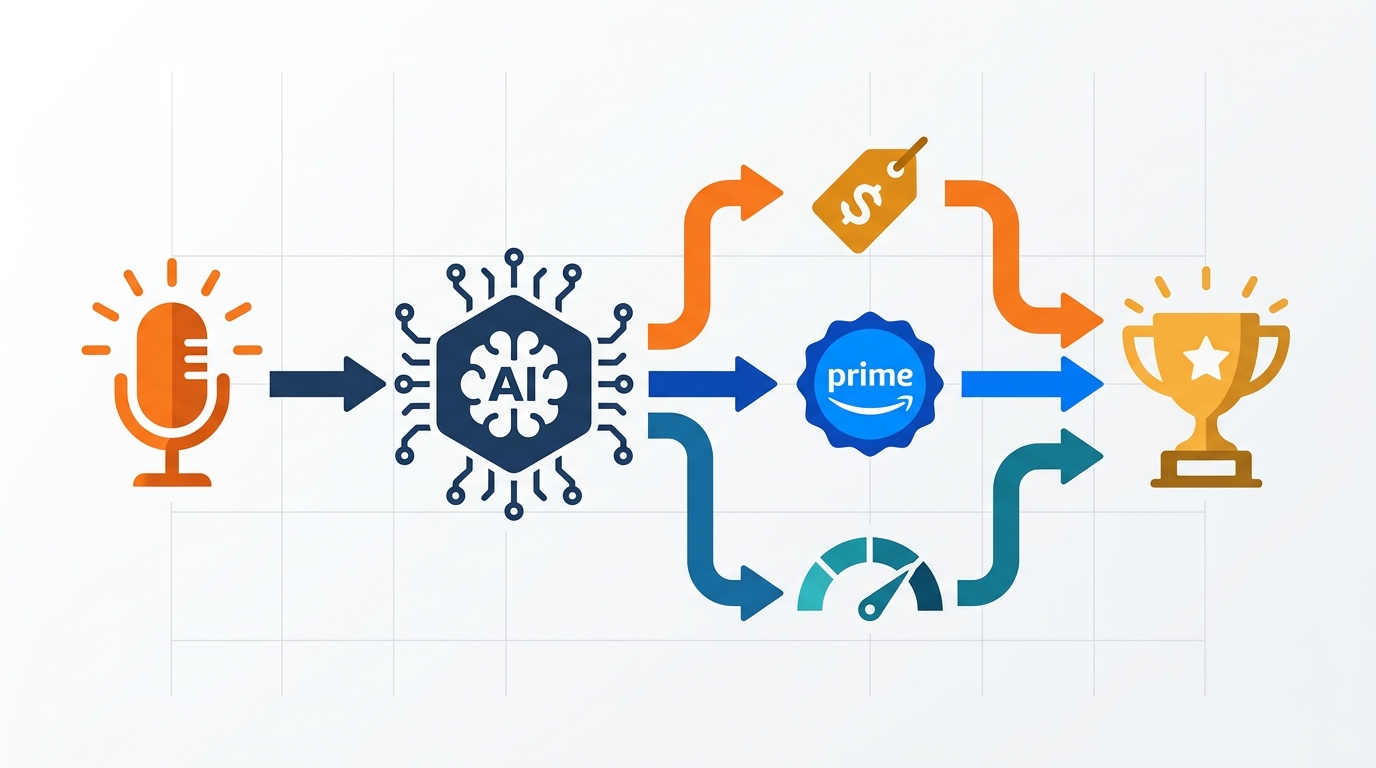
FBA sellers often have an advantage because Prime eligibility and fulfillment reliability are important in fast shopping journeys. If a customer asks Alexa for Shopping to add a product to their cart, Amazon is unlikely to prioritize an offer with poor availability, weak seller metrics, or an uncompetitive price.
This means you should not treat Alexa for Shopping optimization as a copywriting project only. You need to align listing quality with offer quality.
Before investing heavily in AI-readability rewrites, check:
- Are you consistently winning the Buy Box?
- Is your offer Prime eligible?
- Is your price competitive?
- Do you have strong recent reviews?
- Is your inventory stable?
- Are your seller metrics healthy?
If the answer is no, your listing may become easier to recommend, but the order may still go to a competitor or fail to convert.
Mistakes That Hurt Your Alexa for Shopping Visibility
Watch Out For This First
Keyword stuffing your title at the expense of natural phrasing. A title like “Protein Powder Whey Isolate Chocolate Vanilla Unflavored 2lb 5lb Bulk Gym Muscle” may include keywords, but it is difficult to parse as a clean product description. Keep your title as a natural noun phrase with one primary product type, one primary variant, and one key differentiator. Use bullets and backend fields for secondary keyword coverage.
1. Writing vague bullets
Generic claims like “premium quality,” “designed for your lifestyle,” and “perfect for everyday use” do not help AI shopping assistants understand when to recommend your product. Replace vague benefits with specific attributes, measurable facts, and clear use cases.
2. Ignoring structured attributes
Many sellers optimize visible content but leave backend attributes incomplete. This is a mistake. Structured data helps Amazon understand the product category, material, size, compatibility, flavor, target audience, and features.
3. Leaving Q&A unanswered
Q&A is a natural-language asset. If shoppers are asking questions and your brand is not answering them clearly, you are leaving customer intent uncovered.
4. Optimizing only for short keywords
Short keywords still matter, but conversational queries are longer and more specific. Your listing should answer phrases like “best protein powder without artificial sweeteners” or “quiet blender for small apartment,” not only “protein powder” or “blender.”
5. Forgetting the Buy Box
AI readability can improve product discovery, but the purchase still depends on offer-level execution. If your offer is not competitive, you may lose the sale even if the product is relevant.
6. Treating AI shopping optimization as a one-time task
AI shopping behavior will continue to evolve. Competitors will update their listings. Amazon will refine its shopping assistant experience. Your top ASINs should be reviewed at least quarterly for AI readability, entity coverage, Q&A quality, and offer competitiveness.
Key Takeaways
- Alexa for Shopping represents a broader shift toward conversational and AI-assisted product discovery on Amazon.
- Traditional Amazon SEO is still important, but listings also need to be AI-readable.
- AI-readable listings clearly explain product type, use case, customer intent, attributes, differentiators, and objections.
- Structured attributes, bullets, Q&A, reviews, and offer signals all influence whether a product can be confidently recommended.
- Superlisting.io’s Alexa For Shopping Optimizer helps sellers analyze whether their listings are ready for AI-assisted shopping journeys.
- Buy Box ownership, Prime eligibility, price, reviews, and inventory still matter because recommendation and purchase are two separate steps.
Frequently Asked Questions
What is Alexa for Shopping optimization?
Alexa for Shopping optimization is the process of structuring your Amazon listing so AI-assisted shopping experiences can understand, summarize, compare, and recommend your product. It goes beyond traditional keyword optimization by focusing on product attributes, customer intent, use cases, Q&A coverage, and AI readability.
What is Superlisting.io’s Alexa For Shopping Optimizer?
Superlisting.io’s Alexa For Shopping Optimizer is a feature that analyzes Amazon listings for AI-assisted shopping visibility. You enter an ASIN, select the marketplace, fetch the listing, and the tool reviews whether your title, bullets, attributes, backend keywords, and Q&A coverage are clear enough for conversational shopping experiences like Alexa for Shopping.
Why does Alexa for Shopping optimization matter for Amazon sellers?
Alexa for Shopping changes how customers discover products. Instead of only typing short keywords, shoppers can ask detailed questions, request comparisons, generate shopping guidance, and interact with AI-powered product recommendations. If your listing does not clearly communicate product attributes, use cases, and differentiators, your product may be harder for AI shopping systems to understand and recommend.
Is Alexa for Shopping optimization the same as Amazon SEO?
No. Amazon SEO focuses heavily on keyword indexing, ranking, and conversion. Alexa for Shopping optimization focuses on making your listing understandable for conversational and AI-assisted discovery. The two overlap, but they are not the same. A strong listing in 2026 needs both keyword relevance and AI-readable structure.
How do I optimize my Amazon listing so Alexa for Shopping can recommend it?
Start by rewriting your title and bullets so they clearly explain the product type, use case, target customer, materials, ingredients, compatibility, and differentiators. Complete your backend attributes, answer Q&A with full sentences, improve review recency, maintain Prime eligibility, and protect your Buy Box position.
Does Alexa for Shopping use the same ranking signals as Amazon’s search algorithm?
They likely share some signals, such as relevance, availability, price, reviews, sales performance, and offer quality, but the user experience is different. Traditional Amazon search returns a product grid. Alexa for Shopping can answer a question, compare options, summarize product information, and guide the customer toward a decision. That means your content needs to be useful for both ranking and recommendation.
What role does the Buy Box play in Alexa for Shopping?
The Buy Box still matters because product recommendation and order execution are separate. Even if your product is relevant, the sale depends on which offer is competitive, Prime eligible, available, and trusted at the moment of purchase. Sellers should optimize both listing readability and offer performance.
Can I use the same listing strategy for Amazon search, Rufus, and Alexa for Shopping?
You can use the same foundation, but the strategy needs to be broader than keyword insertion. Your listing should include classic Amazon SEO keywords, clear product attributes, natural-language answers, comparison-friendly content, and customer objection handling. This makes the listing stronger for search, AI shopping assistants, and human shoppers.
Conclusion
Alexa for Shopping is not just another voice feature. It represents a broader shift in how customers discover, compare, and buy products on Amazon. Search is becoming more conversational, more personalized, and more dependent on whether Amazon’s AI can understand your product clearly.
That does not mean traditional Amazon SEO is dead. Keywords, indexing, conversion rate, reviews, price, Prime eligibility, and Buy Box ownership still matter. But they now need to work alongside a new layer: AI readability.
The sellers who win in this environment will not be the ones who stuff the most keywords into their title. They will be the ones whose listings clearly explain:
- what the product is,
- who it is for,
- what problem it solves,
- what makes it different,
- which customer questions it answers,
- and why it should be recommended in a specific buying situation.
That is exactly why we built the Alexa For Shopping Optimizer inside Superlisting.io.
Before your next major traffic event, run your top ASINs through Superlisting.io’s Alexa For Shopping Optimizer. In a few minutes, you can see whether your listing is structured for AI-assisted shopping, where your entity gaps are, and which fields should be rewritten first.
Because in 2026, being found on Amazon is no longer only about ranking for what customers type. It is about being recommended when customers ask.
External references: Amazon announcement on Alexa for Shopping | Amazon Ads | Amazon Seller Central
Tags
Ready to Optimize Your Amazon Listings?
Start using AI-powered optimization to rank higher and sell more.
Create a free account