Amazon SEO Consultant (2026): The System to Rank Higher, Convert More, and Grow Organic Sales
Last updated: February 2026

Amazon SEO Consultant: The Complete 2026 Guide to Ranking Products and Growing Organic Sales
If you typed Amazon SEO consultant into Google, you are likely looking for something very specific. Not “tips”. Not “best practices”. Not a generic blog post that tells you to “add keywords” and “improve images”.
You want clarity. You want a system. You want to know what actually moves the needle when you are trying to rank on Amazon, especially in a market where every category feels crowded and every competitor looks “optimized”.
This is a pillar guide. It is intentionally long. It is meant to be bookmarked, shared, and used as a working reference. It explains what an Amazon SEO consultant does, how Amazon SEO works in 2026, and how to audit and fix listings using a repeatable process.
It is also written for humans. I will keep it practical, occasionally opinionated, and as entertaining as a topic like “search ranking systems” can be. Because the truth is: if you are selling on Amazon, SEO is not a side quest. It is a core lever for growth, profitability, and survival.
What you will learn in this guide
- What an Amazon SEO consultant actually does (and what they do not)
- How Amazon search rankings work in 2026 ?
- Why most Amazon SEO fails (even when the listing “looks optimized”)
- The consultant framework: relevance, conversion, consistency
- How to build a keyword strategy using your own Amazon data
- A full Amazon SEO audit checklist you can run today
- How to measure progress without getting tricked by noisy metrics
- FAQs and schema you can deploy for SEO and featured snippets
Quick definition: What is an Amazon SEO Consultant?
An Amazon SEO consultant helps brands increase organic visibility and sales on Amazon by improving how listings are discovered and chosen. That includes keyword strategy, listing structure, conversion optimization, creative hierarchy, and performance feedback loops.
If that sounds broad, it is. Because Amazon SEO is not only “keywords”. Keywords help you get found. Conversion helps you stay ranked. A consultant’s job is to connect those dots and create a system that holds up when competition, pricing, or buyer behavior changes.
Think of an Amazon SEO consultant as someone who does three things:
- Diagnoses why your product is not ranking or not converting
- Builds an optimization plan that prioritizes what matters most
- Implements or guides execution with measurement and iteration
Most sellers do not lose because they do not work hard. They lose because they work hard on the wrong things, in the wrong order. That is where consultants earn their keep.
Why this keyword matters: “Amazon SEO Consultant” is a hiring query
Not all keywords are equal. Some are informational (“what is Amazon SEO?”). Some are transactional (“Amazon SEO consultant”).
When someone searches Amazon SEO consultant, they are usually doing one of these:
- Comparing consultants or agencies
- Trying to understand what they should pay for
- Looking for a proven process and evidence of competence
- Trying to solve a ranking or sales problem that has become urgent
So if you are publishing this as a pillar page, your goal is not only to educate. Your goal is to demonstrate that you understand the realities of Amazon and can communicate a clear, credible system. That is exactly what this article is designed to do.
Amazon SEO in 2026: what changed, and what stayed the same
Amazon evolves constantly. UI changes. Ad products evolve. Seller policies update. Competition gets more sophisticated.
But the fundamentals have not changed. Amazon is a marketplace. It is not a search engine that exists to provide information. Amazon exists to drive purchases.
If you want a simplified model of Amazon SEO, it looks like this:
- Relevance: does your product match the query?
- Engagement: do shoppers click when you appear?
- Conversion: do shoppers buy once they land?
- Consistency: do you keep selling reliably without issues?
In 2026, that model is still the backbone of ranking. What changed is the competitive baseline. More sellers understand SEO fundamentals, so “basic optimization” is no longer a differentiator. You need a tighter system, better creative, and better use of data.
Amazon SEO vs Google SEO: the comparison that causes bad decisions
Sellers often bring Google SEO habits into Amazon. It is understandable. The terms overlap: keywords, rankings, optimization. But the success criteria are different.
Google is an information engine. Amazon is a transaction engine.
On Google, you can rank with content, backlinks, and authority signals. On Amazon, you rank by proving you are the best buying outcome for that query.
That means:
- Traffic without sales does not help you for long
- A listing that converts well tends to gain more exposure
- Your offer matters as much as your wording
- Your images matter as much as your copy
An Amazon SEO consultant does not optimize for “ranking” as an isolated goal. They optimize for a listing that wins the click and wins the purchase. That is what creates rankings that hold.
How Amazon search rankings work ?
Amazon does not publicly disclose a full ranking algorithm. But you can observe ranking behavior across categories and infer what the system rewards.
A practical model an Amazon SEO consultant uses is:
1) Relevance signals
Relevance is Amazon’s confidence that your ASIN matches the query. It is influenced by:
- Title, bullets, description, and A+ copy
- Backend search terms (and other backend fields)
- Category placement and attributes
- Semantic alignment (not only exact-match keywords)
Relevance gets you into the “candidate set” for a query. But relevance alone does not guarantee high rank.
2) Performance signals
Once Amazon shows your product, what happens? If shoppers click and buy, your listing sends a strong signal that it satisfied the query.
Performance is influenced by:
- Click-through rate (CTR)
- Conversion rate
- Sales velocity (rate and consistency of purchases)
- Post-purchase signals like returns and customer satisfaction
3) Confidence and stability signals
Amazon prefers stable outcomes. A listing that sells reliably is safer to promote than one that spikes then collapses.
Confidence is influenced by:
- In-stock rate and fulfillment reliability
- Price stability and competitiveness
- Review health (rating, volume, recent trend)
- Account health and policy compliance
This is why Amazon SEO is not “writing”. It is the orchestration of relevance and performance within a stable retail operation.
Why most Amazon SEO fails? (even when the listing looks optimized)
Let’s talk about the most common trap. You open a listing and it looks fine:
- Title is long and keyword-heavy
- Bullets have features
- Images exist
- Backend fields are filled
Yet the product does not rank. Or it ranks for irrelevant terms. Or it ranks but does not sell.
Here is why this happens:
Failure pattern #1: Keyword strategy is not grounded in your data
Many sellers build keyword lists from generic databases. Those tools can be useful, but they do not tell you what works in your account. They do not show your actual conversion signals. They do not show query-level performance tied to your brand.
A consultant starts with your Amazon-native signals first, especially:
- Search Query Performance
- Sponsored Products search term data
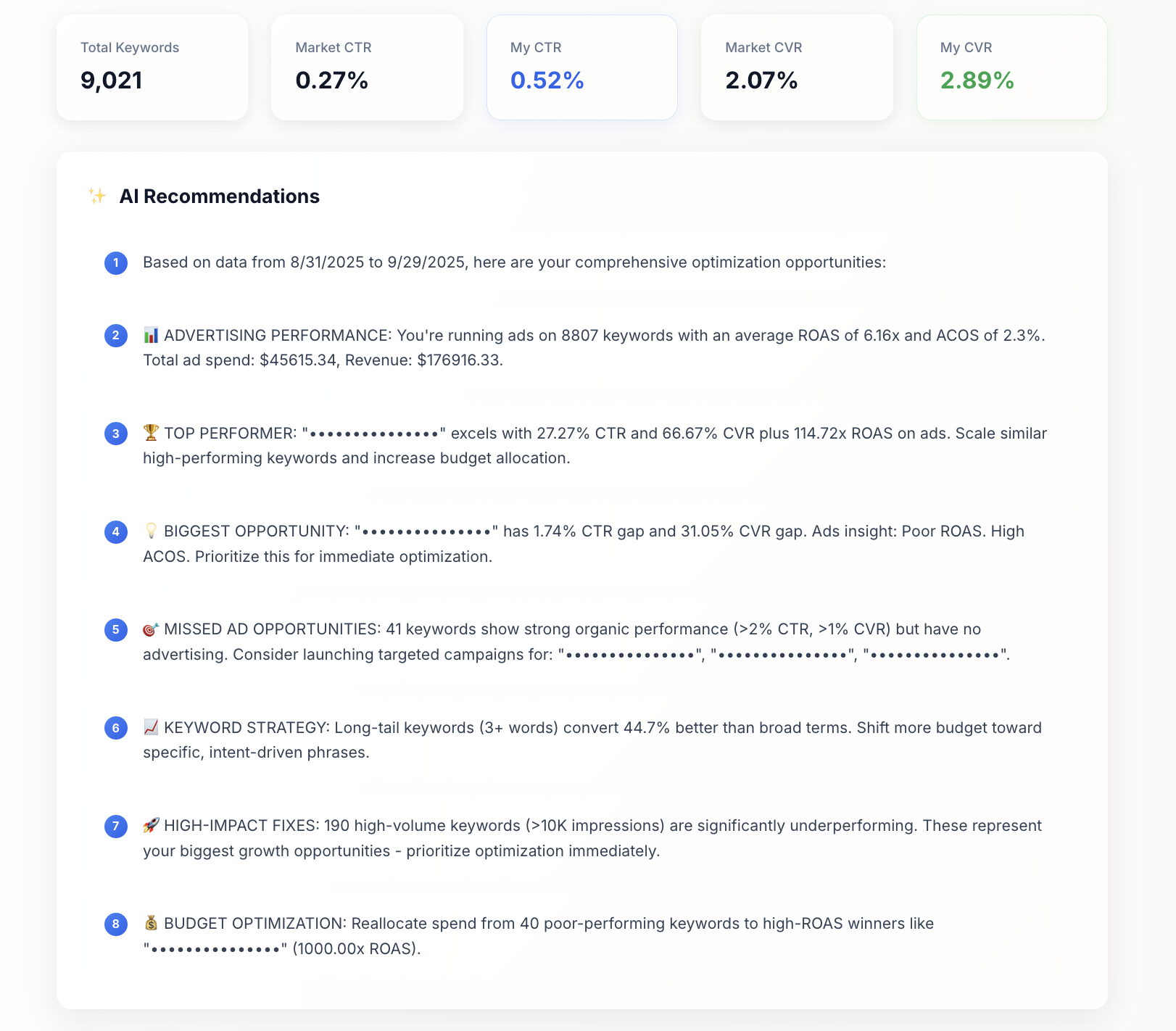
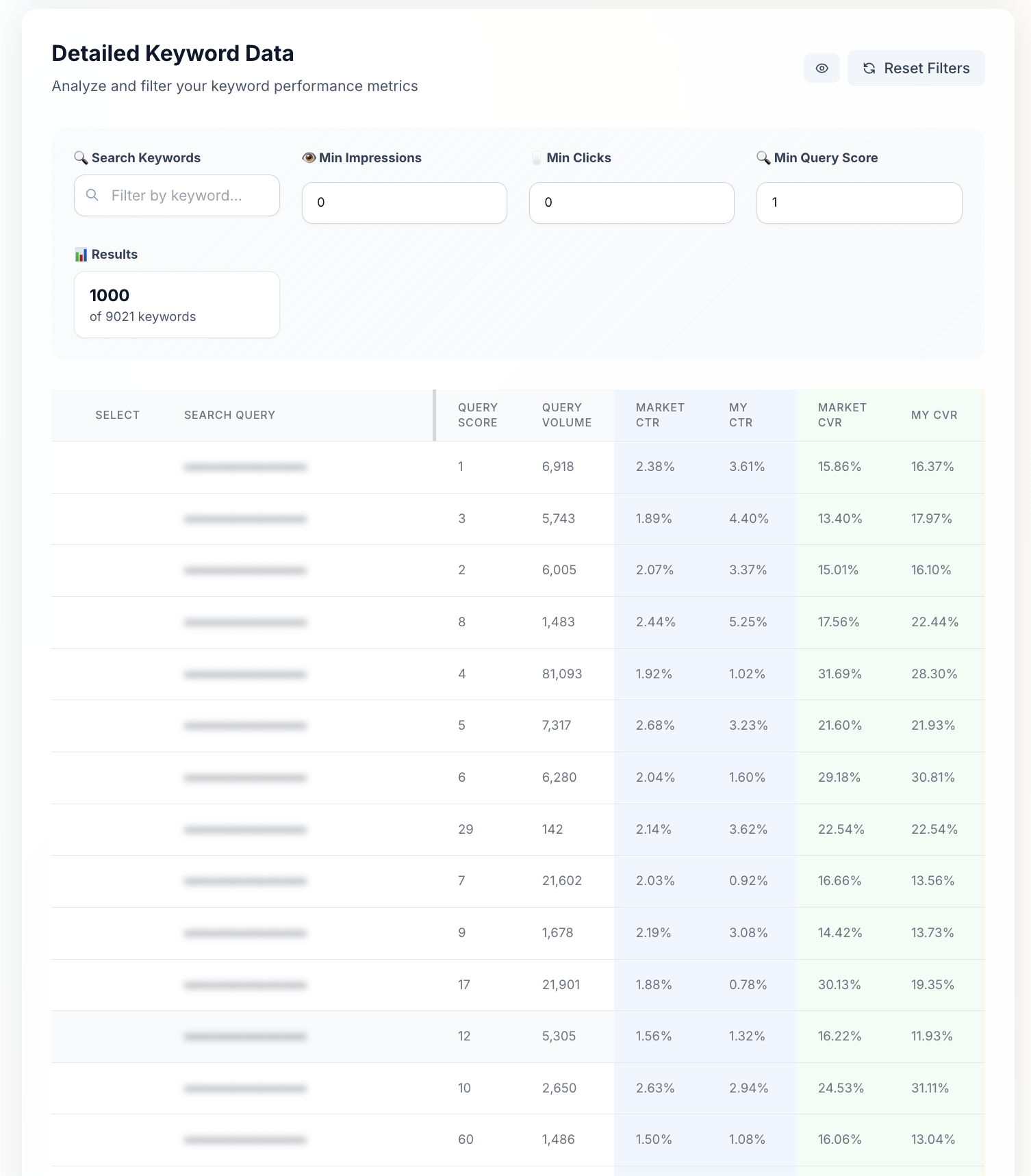
If you want to apply that approach in a structured way, start with the Superlisting.io Keywords Analysis tool. It is designed to help you analyze your Search Query Performance and Sponsored Products Ads data so your keyword strategy is built on what your account is already proving.
Failure pattern #2: Copy is written for robots, not shoppers
Keyword stuffing can increase indexing coverage, but it can also kill conversion. And conversion is not a “nice to have”. Conversion is a ranking force.
If your listing reads like a spreadsheet, shoppers hesitate. Hesitation reduces purchases. Reduced purchases reduce ranking stability.
Failure pattern #3: Creative does not win the click
If your main image does not win in search results, your listing will not get clicks. No clicks means no conversion opportunity. No conversion opportunity means weak performance signals.
SEO and creative are linked. This is why many consultants treat creative work as part of SEO.
If you want to accelerate creative production and structure your visuals properly, the AI Creative Studio is built to generate listing visuals that communicate benefits quickly, especially on mobile.
Failure pattern #4: No measurement, no iteration
Sellers often “optimize” then move on. But Amazon SEO is not a one-time event. It is an ongoing loop.
A consultant tracks change, observes outcomes, and iterates. That is how you compound results.
The consultant framework: Relevance, Conversion, Consistency
If you want one mental model that explains almost every successful Amazon SEO project, use this:
- Relevance: make sure the listing truly matches buyer intent
- Conversion: make sure the listing persuades people to buy
- Consistency: make sure the offer stays stable enough to keep rank
If you skip step 1, you do not rank. If you skip step 2, you do not stay ranked. If you skip step 3, you bounce in and out of visibility and never build durable organic sales.
Most sellers try to do everything at once. Consultants do it in order.
Amazon SEO keyword strategy: how consultants do it? (and why it works)
Keyword research is where most sellers either waste time or build a strategy that looks logical but underperforms. An Amazon SEO consultant approaches keywords differently.
Step 1: Start with what Amazon already shows you
Two data sources are far more valuable than generic “search volume” lists:
- Search Query Performance: query-level visibility and performance signals
- Sponsored Products Ads: what you actually converted on in paid traffic
Why this matters: it ties keywords to outcomes. A keyword that looks big on paper but never converts is not a priority. A keyword that converts for you in Sponsored Products but is missing from your listing is a priority.
This is exactly why the Superlisting.io Keywords Analysis tool is positioned as the “starting tool” in the process. It helps you analyze these reports so your keyword strategy is based on your own account signals, not assumptions.
Step 2: Build a keyword map by intent
A consultant does not create one long list of terms. They build a map. A structured plan that decides where keywords belong.
A simple intent structure:
- Core terms: what the product is
- Use-case terms: when and how it is used
- Problem terms: what pain it solves
- Feature terms: material, size, benefits
- Comparison terms: alternatives and competitor language
This matters because placement matters. Titles are not for everything. Bullets are not for keyword dumping. Backend is not for repetition. A map prevents chaos.
Step 3: Prioritize using an “impact ladder”
If you manage many ASINs, you need prioritization. A consultant prioritizes keywords based on:
- Query-level visibility already present (you are already in the game)
- Conversion evidence (it sells)
- Strategic value (it defines the category or the hero use case)
- Competitive feasibility (you can realistically win)
The goal is to avoid a common time sink: chasing keywords that look attractive but will not become profitable.
Listing optimization: write for shoppers, structure for Amazon?
Now we get to the part people overcomplicate. How to write a listing that ranks and converts.
Here is the consultant approach:
- Write for humans first (clarity wins)
- Structure for Amazon second (coverage and indexing)
- Support performance through creative and offer (conversion)
If you want a structured framework for this, the Amazon SEO Optimization page lays out the workflow as a repeatable system.
The Title: clarity in the first line, relevance without spam
Your title has two jobs:
- Help Amazon understand what the product is
- Help shoppers instantly recognize it as a match
A consultant usually cares about the first 80 characters more than the full title. Why? Mobile. Search results. Scan behavior.
Ask yourself:
- If you only saw the first line, would you know what this is?
- Would you know who it is for?
- Would you know why it is better?
Bullet points: benefits first, objections second, features supporting
Most bullet points are feature dumps. Consultant bullets are decision support. They answer buying questions, reduce doubt, and make the product easy to choose.
A strong bullet structure:
- Bullet 1: the main outcome (why it exists)
- Bullet 2: key differentiator (why this version is better)
- Bullet 3: proof and details (material, durability, performance)
- Bullet 4: use-case clarity (who it is for, how to use)
- Bullet 5: risk reducers (compatibility, guarantee language, support)
Keywords should fit naturally inside that structure. If you have to destroy readability to add a keyword, it is the wrong placement.
Description and A+ Content: the part that saves the sale
Descriptions rarely close the sale by themselves. But they often prevent a lost sale.
They help when shoppers are uncertain. They answer questions like:
- Is this the right size for me?
- Will it work with what I already own?
- How does it compare to the alternative I was considering?
- What happens if it does not work?
A+ Content, when available, should not be used as “brand wallpaper”. It should be used as a conversion asset: comparison charts, use cases, step-by-step usage, benefit visuals, credibility.
Creative optimization: the missing half of Amazon SEO?
If you want to rank on Amazon, you need clicks. If you want clicks, you need a main image that wins at thumbnail size.
That is why an Amazon SEO consultant cares about creative. Not because it is fun (sometimes it is). Because it affects CTR, conversion, and therefore ranking.
The main image: the click gatekeeper
Your main image is your billboard. It competes against a row of other billboards. Most sellers think their main image “meets requirements”. That is not enough. You need to win.
A consultant looks for:
- Instant recognizability
- Clean composition
- Readable product silhouette
- Confidence in what is included
If your category is saturated, your main image becomes a strategic asset.
Secondary images: explain benefits, not angles
Secondary images are where you do the heavy lifting:
- Benefits
- Use cases
- What is included
- How it works
- Proof points
This is where the AI Creative Studio fits into the workflow. It is designed to generate visuals that are conversion-driven: clear hierarchy, benefit-forward, mobile-first. Not random “AI art”.
The “mobile scan test” (quick audit)
Open your listing on a phone. Scroll quickly. Ask:
- Do I understand the product within 3 seconds?
- Do I understand why it is better within 10 seconds?
- Do I see proof or credibility within 15 seconds?
If the answer is no, your conversion is capped. And so is your ranking.
Backend keywords and attributes: the silent SEO layer
Backend fields matter, but they are often misunderstood.
A consultant uses backend keywords to expand coverage without harming readability. They typically include:
- Synonyms
- Alternate spellings
- Related terms that do not fit naturally in copy
- Long-tail phrases that support niche discovery
But backend fields are not a dumping ground. They are limited space. Use them intentionally.
Attributes also matter. Incorrect attributes reduce filter visibility, category relevance, and indexing quality. This is “unsexy SEO”, but it can have outsized impact.
Advertising and SEO: the feedback loop consultants use
Many sellers separate SEO and ads as two different departments. That is a mistake.
Ads generate data faster. SEO benefits from that data.
A common consultant loop:
- Use Sponsored Products to test queries and gather conversion evidence
- Identify converting search terms
- Integrate those terms into the listing where appropriate
- Improve organic visibility and reduce reliance on ads for that query
This is not theoretical. It is a practical way to reduce guesswork and build SEO around what sells.
If you want to operationalize this, start by analyzing your ad search terms and Search Query Performance using the Keywords Analysis tool.
How long Amazon SEO takes (honest expectations)
If someone promises instant rankings, be cautious. Amazon SEO takes time because Amazon rewards proven performance, not edits.
What you can expect depends on:
- Category competition
- Your current baseline (reviews, price, conversion)
- How many changes you make and how well you execute
- How much data your listing generates
A consultant typically sets expectations around:
- Indexing verification and early signals in the first few weeks
- Early movement as Amazon re-tests your listing
- Meaningful traction after sustained performance improvements
The key is to avoid impatience-driven chaos. If you change everything every week, you never learn what worked.
Amazon SEO Audit Checklist (Consultant Framework)
This is the checklist an Amazon SEO consultant uses when auditing a listing. Use it to identify why an ASIN is not ranking, not converting, or stuck in a plateau. Run it before you rewrite anything.
1) Keyword and Indexing Audit
- Is the ASIN indexed for its primary keyword (confirmed by search behavior tests)?
- Is the primary keyword present naturally in the title?
- Are secondary keywords distributed across bullets and description where they make sense?
- Are backend search terms filled intentionally (unique terms, no repetition, no spam)?
- Are key converting Sponsored Products search terms missing from the listing?
- Is Search Query Performance data used to prioritize keywords and opportunities?
- Are category and subcategory placements correct?
- Are attributes (size, material, compatibility, intended use) complete and accurate?
2) Title Audit (Mobile First)
- Does the first 80 characters clearly describe what the product is?
- Does the title avoid redundancy and keyword stuffing?
- Does it include a meaningful differentiator or use-case cue?
- Is it readable for humans, not just searchable for robots?
3) Bullet Points Audit
- Do bullets lead with benefits and outcomes?
- Do they answer common objections (fit, durability, usage, compatibility)?
- Is buyer language from reviews and Q&A reflected in phrasing?
- Are keywords integrated naturally without harming clarity?
- Is the structure scannable on mobile?
4) Description and A+ Content Audit
- Does the description clarify usage and reduce uncertainty?
- Does A+ Content provide persuasion assets (comparison, proof, use cases)?
- Does the content align with the keyword intent (not generic brand storytelling)?
- Is the page structured for quick scanning?
5) Creative and CTR Audit
- Does the main image win at thumbnail size?
- Is the product instantly recognizable and clearly framed?
- Do secondary images explain benefits, not just angles?
- Is there a clear hierarchy (what it is, why it matters, proof points)?
- Does creative match the intent of the main keywords?
6) Trust, Offer, and Conversion Audit
- Is the review rating competitive in the category?
- Are recurring negative themes addressed in copy or visuals?
- Is pricing aligned with perceived value relative to competitors?
- Is the offer clear (what is included, what you get, what to expect)?
- Is inventory stable and consistently in stock?
- Is the buying experience frictionless (variations, shipping promise, returns clarity)?
7) Performance Feedback Loop Audit
- Are listing changes documented with dates and reasons?
- Are CTR and conversion tracked after updates?
- Are ad search terms used as SEO inputs regularly?
- Is there a monthly optimization cadence (not random edits)?
Pro tip: If you fail multiple items in sections 5 and 6, do not blame SEO. Fix conversion first. Ranking stability usually follows performance.
The step-by-step consultant workflow you can copy
Now let’s turn the concepts into an execution plan. If you want to operate like an Amazon SEO consultant, follow this workflow. It is designed to reduce wasted effort and create measurable progress.
Step 1: Collect your real data (before you touch copy)
- Search Query Performance data (brand query performance)
- Sponsored Products search term data (query-level results)
- Business reports: sessions, unit session percentage, sales trend
- Review themes and Q&A questions (objections and language)
- Competitor scan: what do top listings communicate visually and verbally?
Use the Keywords Analysis tool to speed up the keyword analysis and prioritize opportunities based on your own account signals.
Step 2: Build a keyword map (not a list)
Group terms by intent and decide placement:
- Title: core term, variant, main differentiator
- Bullets: benefit terms, use cases, objections
- Description and A+: deeper persuasion and secondary intent
- Backend: synonyms, long-tail support, alternate spellings
Step 3: Rewrite for clarity and conversion
Rewrite the title and bullets to be readable first. Then validate that keyword coverage is intact. This is the opposite of keyword stuffing. It is keyword coverage that still sounds like a confident brand.
If you want a structured writing system, follow the workflow on Amazon SEO Optimization.
Step 4: Upgrade creative to win the click
Create or refresh visuals with a conversion-first hierarchy:
- Main image: clarity and confidence
- Image 2: key benefit
- Image 3: proof or differentiator
- Image 4: use case or “how it works”
- Image 5: comparison or credibility
If you want to accelerate production and keep visuals structured, use the AI Creative Studio to generate mobile-first listing visuals designed to convert.
Step 5: Launch changes with measurement discipline
Do not change everything every week. Change in controlled batches. Document the date, what changed, and why. Measure:
- CTR trend
- Conversion trend
- Query-level movement in visibility and sales
- Organic sales trend (not day-to-day noise)
Step 6: Iterate monthly
Amazon SEO is a cadence, not a project. Run monthly reviews:
- New converting queries in ads that should be added
- Queries where you get impressions but weak clicks (creative problem)
- Queries where you get clicks but weak conversion (offer or trust problem)
This is how your SEO compounds instead of resetting every quarter.
How to choose an Amazon SEO consultant (without getting sold fluff)
If you are hiring, here is the reality. Many people can rewrite a listing. Fewer people can diagnose why you are not ranking. Even fewer can build a system that keeps working after the rewrite.
Questions to ask a potential Amazon SEO consultant
- How do you build keyword strategy: generic tools or Amazon account data?
- How do you prioritize across many ASINs?
- Do you treat creative and conversion as part of SEO?
- How do you measure success beyond “rank screenshots”?
- What is your iteration cadence?
- How do you handle compliance and category restrictions?
Red flags
- Guaranteeing rank positions
- Only talking about keyword insertion
- No mention of Search Query Performance or ad search term data
- No structured audit process
- Vague reporting (“we optimize and you will grow”) without specifics
A good consultant sounds boring in a good way. They talk about process, measurement, and trade-offs. They do not pitch miracles.
Real-world “case studies” without fake numbers: how to present proof correctly
You asked not to include fake case studies with fake metrics. That is the right call, especially for a pillar page meant to rank and build trust.
Here is the better approach: publish proof with structure. Even if you only share a few examples, do it credibly.
This is enough to show competence without exaggeration. And it is exactly the kind of content that increases trust, improves time on page, and supports ranking for hiring-intent searches like “Amazon SEO consultant”.
Measuring Amazon SEO results (without being tricked by vanity metrics)
If you only track rank screenshots, you will make bad decisions. Rankings fluctuate. Personalization exists. Location matters. Search results are dynamic.
A consultant measures a mix of:
- Query-level visibility: are you getting more impressions on priority terms?
- Click performance: is CTR improving for key queries?
- Conversion performance: is unit session percentage improving?
- Organic sales trend: are organic orders and revenue growing over time?
- Profit reality: are you growing profitable sales, not just volume?
The goal is not to win one keyword. The goal is to build a listing and offer that generates durable organic sales across a cluster of relevant terms.
Tools and resources (Superlisting.io stack, consultant-style)
Tools do not replace strategy. But the right tools reduce time, reduce chaos, and make it easier to run an optimization cadence. Here are three resources that align directly with the consultant workflow in this article:
- Keywords Analysis tool: analyze Search Query Performance and Sponsored Products Ads data to build keyword strategy from real account signals.
- Amazon SEO Optimization: a structured framework for listing optimization that prioritizes relevance and conversion in the right order.
- AI Creative Studio: create conversion-driven listing visuals that improve CTR and support organic ranking stability.
Used together, these resources support the core consultant loop: data-driven keyword strategy, structured listing execution, conversion-first creative, and monthly iteration.
Conclusion: What actually ranks products on Amazon
If you remember one thing from this guide, make it this:
Amazon SEO is not about gaming the system. It is about aligning with what Amazon rewards. Amazon rewards listings that match intent, get clicked, convert reliably, and deliver stable buyer satisfaction.
That is why the best Amazon SEO consultants do not obsess over keywords alone. They build systems: data-driven keyword maps, human-readable copy, conversion-driven creative, and disciplined iteration.
If you want to apply this process with structure, start here:
- Analyze your Search Query Performance and Sponsored Products Ads data with the Keywords Analysis tool
- Execute listing updates using the framework in Amazon SEO Optimization
- Improve CTR and conversion with mobile-first visuals using the AI Creative Studio
That is how you stop guessing and start building organic growth you can rely on.
Frequently Asked Questions (Amazon SEO Consultant)
An Amazon SEO consultant helps brands increase organic visibility and sales on Amazon by improving how listings are discovered and chosen. This includes keyword strategy, listing structure, conversion optimization, creative hierarchy, and a performance feedback loop. The best consultants start from Amazon-native signals like Search Query Performance and Sponsored Products search term data to prioritize what will actually drive growth.
Yes. Amazon SEO is still one of the most durable growth levers because strong organic rankings can reduce dependency on ads over time. In 2026, basic “keyword insertion” is not enough. The brands that win treat SEO as a system: data-driven keywords, conversion-first listings, strong creative, and consistent iteration.
Amazon SEO is rarely instant because Amazon rewards proven performance, not edits. Timelines depend on category competition, your current conversion rate, review health, and inventory stability. You can often see early movement after Amazon re-tests your listing, but meaningful organic growth typically comes from consistent improvements in CTR and conversion over multiple weeks.
Yes. Backend keywords help expand indexing coverage, especially for synonyms and long-tail variations. Best practice is to keep backend terms unique, relevant, and non-repetitive. Use backend fields to add coverage you cannot include naturally in front-end copy without harming readability.
Yes. Google is primarily an information engine. Amazon is a transaction engine. On Amazon, rankings are heavily influenced by click-through rate, conversion rate, and sales consistency. In plain terms: Amazon rewards what sells, and what keeps selling without operational issues.
You can do Amazon SEO yourself if you have a small catalog and time to test and iterate. Hiring an Amazon SEO consultant makes sense when you manage many ASINs, need clear prioritization, want to reduce trial and error, or you are stuck in a ranking plateau despite effort. A strong consultant brings a repeatable audit process, execution structure, and measurement discipline.
The main drivers remain consistent: relevance (keyword + indexing alignment), performance (CTR, conversion, sales velocity), and confidence (reviews, price competitiveness, in-stock reliability). The key is the order of operations: fix relevance first, improve conversion second, and protect consistency so rankings hold.
Strong consultants do not rely only on generic keyword lists. They start with your Amazon-native data: Search Query Performance and Sponsored Products search term performance. This reveals which queries drive visibility, which generate clicks but not purchases, and which converting paid terms should be integrated into the listing to strengthen organic relevance.
Impressions without sales usually means either intent mismatch (ranking for the wrong terms) or a conversion problem (offer, creative, reviews, pricing, or clarity). Start by auditing your main image for CTR, then your first bullets for clarity, then your reviews and price positioning.
This often happens when the listing is not aligned with the converting search terms. If certain queries convert in Sponsored Products but those terms are missing (or poorly placed) in the title, bullets, and backend keywords, relevance signals may be too weak for organic ranking to improve. Use converting ad terms as SEO inputs, integrate them naturally, and monitor organic visibility over time.
Do not rely only on rank screenshots. A stronger measurement stack includes query-level visibility (impressions on priority terms), CTR trend, conversion trend, organic sales trend, and review health over time. Amazon SEO compounds, so measure progress over weeks, not day-to-day noise.
Tags
Ready to Optimize Your Amazon Listings?
Start using AI-powered optimization to rank higher and sell more.
Try SuperListing Free